B.R Restoration Red Bank
📞 848-337-3654
Property Damage Restoration Clifton, NJ
Red Bank • NJ

Mold Remediation in Red Bank.

Visible mold is the symptom; the moisture source is the problem. We find both, fix both, and document both for your carrier.

📞 848-337-3654 Local team in Red Bank 24/7 dispatch
Local Monmouth County base
Carrier-Ready NJM / Travelers / Liberty / Allstate
24/7 Live dispatch every day
Service Overview

How We Approach It

Mold remediation is what happens when a water event was not properly dried, or when a chronic moisture problem was ignored long enough for fungal growth to establish. We follow the IICRC S520 standard for safe, effective mold removal in Red Bank properties.

What's Included

  • IICRC S520 protocol
  • Negative-air containment
  • HEPA filtration
  • Source removal to documented line
  • Antimicrobial application
  • Optional 3rd-party clearance testing

Source Moisture: the Step Most Cleanups Skip

Mold needs three things to grow: moisture, organic material, and time. Organic material is everywhere in a building (drywall, wood, dust). Time is unavoidable. The only variable a remediator controls is moisture. If the source moisture is not eliminated, the mold returns regardless of how thoroughly the cleanup was performed.

Common moisture sources in Red Bank properties: roof leaks (intermittent — only during rain events, easy to miss), plumbing leaks (slow drips behind walls, often discovered only when staining or odor appears), foundation seepage (basement water during heavy rain), HVAC condensate failures (drain pan overflow, frozen evaporator coil melt), inadequate bathroom ventilation (chronic high humidity in poorly-vented bathrooms), and ground-water infiltration in below-grade spaces.

Our scope-of-work for any mold remediation includes a source-moisture investigation as phase one. If the source is a plumbing leak, we coordinate with a plumber to repair before remediation. If it is a roof leak, the roof gets repaired first. If it is HVAC, the HVAC tech gets involved. Skipping this step guarantees the mold returns. We do not skip it.

Containment + Hepa Filtration — Why the Plastic Sheeting Matters

If you walk into a mold remediation job and the contractor is not running HEPA-filtered negative-air containment, walk back out and call someone else. Disturbing mold growth releases millions of spores into the air. Without containment, those spores spread throughout the rest of the property — turning a contained 200 sqft mold problem into a whole-house contamination event.

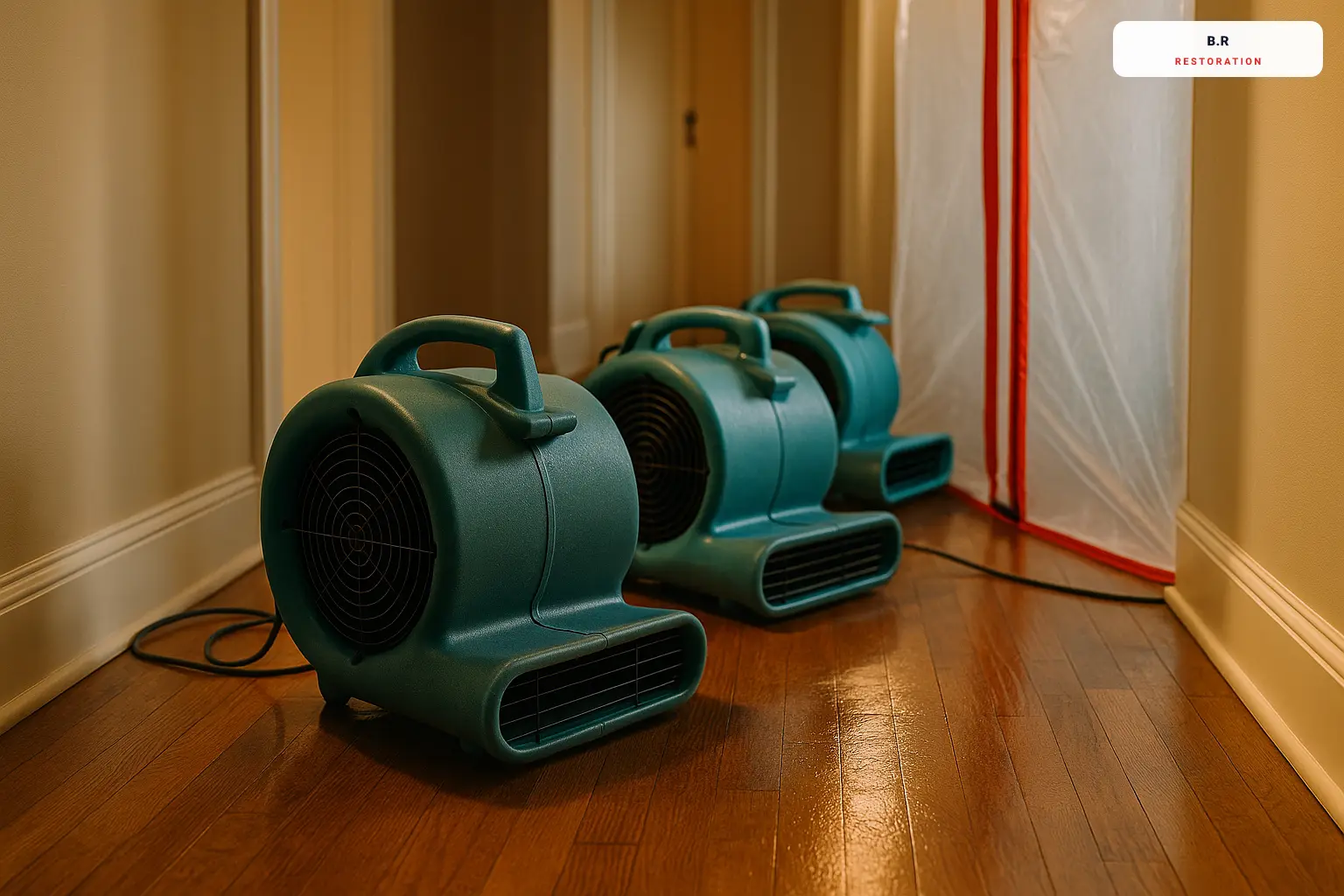
Proper containment: 6-mil plastic sheeting + zip-wall framing creates a sealed barrier between the affected area and the rest of the structure. HEPA-filtered air scrubbers run inside the containment to capture airborne spores during the work. Negative-air pressure differential (containment is at lower pressure than the rest of the structure) means any air leakage flows INTO the containment rather than out. PPE for the techs: Tyvek suits, respirators with P100 cartridges, gloves, foot covers.

This setup adds equipment cost and labor time to a remediation job, which is why fly-by-night operators skip it. The cost difference shows up later — when the contamination has spread to areas it was not in before, and the second remediation is 3-5x the first.

Process

Our Process

  1. 01

    24/7 Dispatch

    Live answering service routed directly to dispatch. Most Red Bank addresses see a truck within 60 minutes of the call.

  2. 02

    Iicrc S500 Protocol

    Loss category established (Cat-1, Cat-2, Cat-3) on first inspection. Protocol matched to category — no shortcuts on contaminated water cleanup.

  3. 03

    Industrial Drying

    Truck-mounted extraction, high-velocity air movers, LGR dehumidification, HEPA-filtered negative air when needed. Equipment sized to the loss, not under-spec to save cost.

  4. 04

    Verified Moisture Clearance

    Final clearance readings on every substrate before reconstruction starts. We do not close the mitigation phase on "looks dry" — we close it on documented moisture content at baseline.

  5. 05

    Single-source Reconstruction

    Rebuild scope mapped directly from mitigation documentation. No contractor handoff, no scope renegotiation, no surprise costs three weeks in.

The difference

Why Customers Choose Us

Real reasons. No invented stats, no manufactured awards.

  • 01

    Owner-Led Operations

    Direct access to the owner during your project, not a project-coordinator buffer. Decisions get made fast. Issues get resolved without waiting for a callback from someone who has to "check with the boss."

  • 02

    Documented Drying, Not Guessed

    Calibrated moisture meters on every wet substrate, daily readings logged, equipment repositioned based on what is actually drying. We close the mitigation phase only when readings return to dry-standard for each material.

  • 03

    Built For Red Bank Properties

    Older NJ housing has galvanized supply lines, plaster walls, original hardwood, and the kind of architectural detail that has to be preserved through any restoration job. We know what we are walking into.

Service Area

Serving Monmouth County

From our Red Bank base we cover Monmouth County and the immediately surrounding NJ municipalities. Sub-hour response on active losses, pre-staged equipment for storm season, IICRC-standard methodology applied to every job regardless of size.

Counties Covered

  • Monmouth County, NJ

Cities We Service

Each Monmouth city below opens a local page with arrival times from our Red Bank base and the loss patterns we handle most often in that municipality.

Not sure if you're in our area? Call 848-337-3654 and we'll tell you in 30 seconds.
FAQ

Frequently Asked Questions

If you don't see your question, just call or message us.

Do you handle storm damage to roofs? +

Emergency tarping yes — we secure compromised roof openings to prevent further weather intrusion. Permanent roof replacement we coordinate with a licensed roofing contractor in our network rather than doing in-house. The water damage that follows roof intrusion is our scope; the structural roof itself is a roofer's scope. We handle the coordination so you have one project manager not two.

How do you document moisture readings for insurance? +

We map every wet substrate on a building diagram, take initial moisture readings with calibrated meters, log readings at every daily monitoring visit, and compare against the manufacturer's dry-standard for that material. Final clearance readings show every wet substrate returned to baseline. Adjusters get the full record — building diagram, meter readings by date, equipment run logs. This is what gets the claim approved without back-and-forth.

What happens if mold is found during the dry-out? +

If we discover existing mold growth during a water restoration job — which happens when a slow leak was already growing mold before the recent loss — we contain that area immediately and remediate per IICRC S520 before reconstruction starts. The discovery becomes a supplemental scope item for the carrier. Done correctly, both the water loss and the pre-existing mold get resolved as one coordinated project.

Do you offer free estimates? +

For property losses (water, fire, storm, sewage), we provide a no-cost on-site assessment and an Xactimate scope of work. For non-emergency reconstruction or mold remediation we provide a written estimate after on-site evaluation. We do not give phone-quote prices for restoration work — accurate scoping requires seeing the loss in person.

What certifications do your technicians hold? +

Our crew holds IICRC certifications in Water Damage Restoration (WRT), Applied Structural Drying (ASD), and Applied Microbial Remediation (AMRT) per IICRC S500/S520 standards. Specific cert status of any technician on your job is available on request — we do not stretch certifications we do not actually hold.

How do you decide what materials to remove vs save? +

IICRC S500 has clear material removal criteria based on water category and how long the material was wet. Cat-1 water + reached within 24-48 hours = often save in place. Cat-3 water = porous materials always come out. Borderline cases get the moisture-meter test: substrate that returns to dry standard with equipment runtime gets saved; substrate that stalls above dry standard for 5+ days gets removed.

Can you work in occupied condo and apartment buildings? +

Yes — we have COIs ($2M general liability + workers comp, additional insured naming the building) on file for most major condo and apartment complexes in our service area. We work within building noise windows, use service elevators, and coordinate with building management on access protocols. For larger buildings we are pre-cleared for vendor approval so paperwork does not delay active-loss response.

Call Now • Red Bank

Red Bank Loss Right Now? Call the Crew That Documents Everything.

One phone call gets a truck rolling. Real Red Bank team, real local response time, no automated phone tree. We'll be on site fast.

📞 Tap To Call 848-337-3654

24/7 Emergency Dispatch

📞 Call 848-337-3654